Beyond Chatbots: Intelligent AI Agents That Understand and Execute Marketing Tasks
Chat AI used to sit safely on the surface, visible, reactive, and easy to ignore. Now it is showing up where decisions are made, budgets are questioned, and performance finally gets measured. When brands start seeing revenue moves of 7-25%, cost reductions reaching 30%, and customer satisfaction pushing 90-94%, curiosity turns into urgency. Something has shifted, and it is happening faster than most teams expected.
This is the moment many businesses pause and look sideways. Not to replace teams, not to chase trends, but to work out what is really doing the heavy lifting behind high-performing marketing operations. If you are sensing that line being quietly crossed, it is worth continuing. What comes next explains why this change matters more than it first appears.
What’s Inside:
- Chatbots vs. Intelligent Chat AI Agents: What’s the Real Difference?
- How Intelligent Chat AI Agents Understand Marketing Intent
- How Chat AI Agents Execute End-to-End Marketing Tasks
- Build a Smarter Marketing Engine With Elephant in the Boardroom
Chatbots vs. Intelligent Chat AI Agents: What’s the Real Difference?
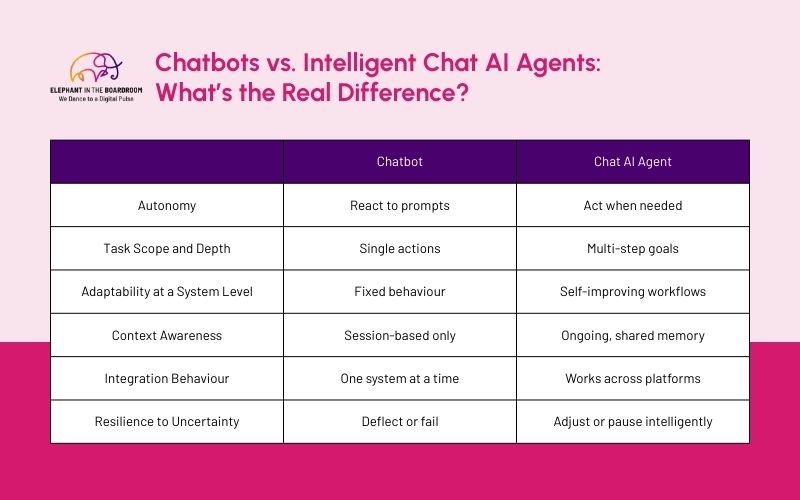
Most businesses are familiar with chatbots that answer questions or direct users to the right page. What is less familiar is the shift happening beneath the surface. Intelligent chat AI agents go beyond conversation, introducing an entirely different model for how AI operates inside marketing systems.
Here’s the real difference between chatbots and chat AI agents:
Autonomy
Chatbots are reactive by design. They wait for prompts and respond within predefined conversational paths. Intelligent chat AI agents, by contrast, are built to operate autonomously within set boundaries, deciding when action is required rather than waiting to be asked.
Task Scope and Depth
Chatbots handle narrowly defined, single-step interactions such as answering FAQs, capturing simple inputs, or routing users. Chat AI agents are designed for multi-step, goal-driven work, where success depends on sequencing actions rather than completing isolated tasks.
Adaptability at a System Level
Traditional chatbots behave consistently over time unless manually reconfigured. Chat AI agents are engineered to evolve at the workflow level, refining how decisions are made and how tasks are approached based on performance patterns and outcomes.
Context Awareness
Most chatbots treat each interaction as isolated, with limited memory beyond the immediate session. Chat AI agents retain awareness of prior interactions, account history, and ongoing objectives, enabling continuity across conversations rather than fragmented exchanges.
Integration Behaviour
Chatbots typically connect to a single system or data source, restricting what they can meaningfully act on. Chat AI agents are designed to operate across multiple platforms, coordinating data and actions across tools instead of functioning in isolation.
Resilience to Uncertainty
When encountering unexpected inputs, traditional chatbots often deflect or return generic responses. Chat AI agents are built to recognise uncertainty and operate within it, selecting alternative paths or deferring action when confidence thresholds aren’t met.
This distinction matters because modern marketing is no longer a set of standalone activities. It is a connected system of decisions, data, execution, and iteration. Intelligent chat AI agents are designed to operate inside that system, reducing friction between insight and action while maintaining momentum without constant manual oversight.
How Intelligent Chat AI Agents Understand Marketing Intent?
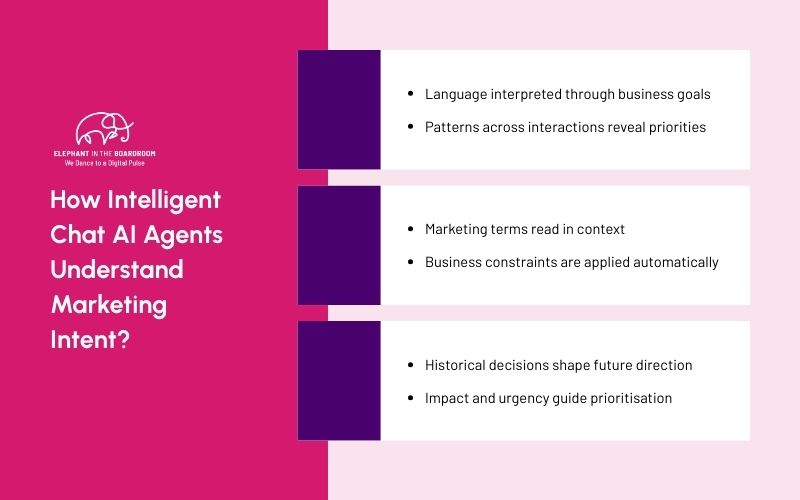
Understanding marketing requests requires more than processing language. It requires interpreting business context, priorities, and constraints before any action is taken. Intelligent chat AI agents are designed to translate conversational input into strategic intent.
Here’s how that understanding takes place:
Language Interpreted Through Business Goals
When someone says, “We need more leads,” agents interpret the underlying objectives, tightening targeting, improving conversion quality, balancing CAC, or growing the pipeline.
Patterns Across Interactions Reveal Priorities
Across repeated requests, refinements, and follow-ups, the agent identifies what matters most and adjusts focus accordingly.
Marketing Terms Read in Context
Words like optimise, scale, or performance take different meanings based on campaign stage, channel, or audience. Agents adapt interpretation to context, not generic definitions.
Business Constraints Are Applied Automatically
Budget limits, timing pressures, compliance requirements, and brand guidelines influence intent, even when unstated.
Historical Decisions Shape Future Direction
Past approvals, changes, and rejected options prevent repetition and maintain strategic continuity.
Impact and Urgency Guide Prioritisation
Agents weigh timelines, expected outcomes, and dependencies to prioritise what will drive the most momentum.
How Chat AI Agents Execute End-to-End Marketing Tasks?
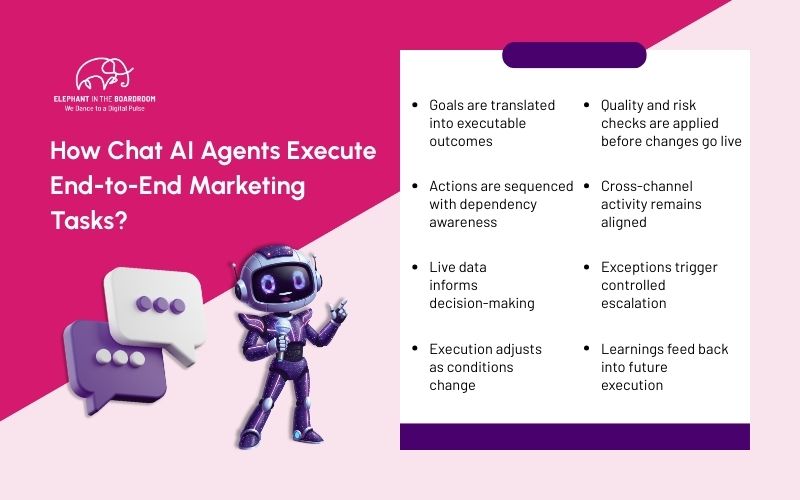
Once intent is clearly understood, execution becomes coordinated, continuous, and outcomes-focused. This is where intelligent chat AI agents move beyond interpretation and into action.
Here’s how chat AI agents execute end-to-end marketing tasks:
Goals Are Translated into Executable Outcomes
High-level objectives such as improving lead quality or increasing conversion efficiency are converted into specific, measurable actions aligned to channels, audiences, and conversion points.
Actions Are Sequenced with Dependency Awareness
Tasks are ordered based on timing, data availability, and channel relationships, so each action enables the next. This prevents fragmented execution and reduces rework caused by missing inputs or poor sequencing.
Live Data Informs Decision-Making
Instead of relying on static reports, agents pull signals from connected systems such as analytics platforms, CRMs, and campaign data in real time, ensuring execution reflects current conditions.
Execution Adjusts as Conditions Change
When performance shifts, volumes fluctuate, or signals weaken, actions recalibrate automatically. This allows momentum to continue without waiting for scheduled reviews or manual intervention.
Quality and Risk Checks Are Applied Before Changes Go Live
Brand guidelines, compliance requirements, spend limits, and risk thresholds are validated before execution, balancing speed with control.
Cross-Channel Activity Remains Aligned
Changes in one channel account for downstream effects in others, preventing inconsistent messaging, conflicting targeting, or inefficient spend across platforms.
Exceptions Trigger Controlled Escalation
When uncertainty exceeds predefined thresholds, execution pauses or reroutes appropriately. This keeps humans in the loop without bringing progress to a halt.
Learnings Feed Back into Future Execution
Outcomes inform how future tasks are prioritised, sequenced, and refined. Over time, execution improves quietly in the background without repeated instruction.
Build a Smarter Marketing Engine With Elephant in the Boardroom
The shift is already here, and waiting usually costs more than acting. This is where Elephant in the Boardroom helps brands move with clarity and confidence. As global leaders in AI-first digital, we bring strategy, design, development and digital marketing together under one roof, built to perform as one intelligent system rather than a collection of parts. If your business is ready to stop reacting and start leading, now is the right time to talk. Connect with Elephant in the Boardroom and turn momentum into measurable growth, built to scale, adapt and outperform.

Candace - Co-Founder and Head of Marketing
Elephant Candace is Co-Founder and Head of Marketing at Elephant in the Boardroom, where she leads brand, growth, and digital strategy across multi-channel platforms. With over 10 years of experience in digital marketing, web development, and performance strategy, she brings expertise in customer acquisition, conversion optimisation, and data-driven storytelling. She contributes insights on modern marketing, AI-led growth, and digital transformation, drawing on experience working with enterprise-scale organisations and cross-functional global teams.