Smarter Websites: How AI Personalisation in Website Design Will Shape User Journeys in 2026
Netflix has set the bar high for all of us. You open the app for a quick browse, and suddenly it’s serving up a show you didn’t even know you wanted yet. If Netflix can predict what you’ll watch next, why can’t your website predict what a visitor wants before they even ask for it? That’s the energy AI personalisation in website design brings, making every click feel smoother, smarter and way more in tune with what people actually come for.
And if that spark of possibility already feels exciting, don’t stop here. This shift is becoming something businesses can’t afford to sit out, especially with user expectations rising fast. Keep reading to see how this next level of personalisation will influence the way people move through your site and why it’s shaping up to be a must-have for brands aiming to stay ahead.
What’s Inside:
- What Is AI Personalisation in Web Design?
- Smarter Websites: How AI Personalisation in Website Design Will Shape User Journeys in 2026
- AI Personalisation in Website Design: Key Steps to Get Started Today
- Take Your Next Digital Leap with AI Personalisation in Website Design
What Is AI Personalisation in Web Design?
AI personalisation in website design uses machine learning and behavioural data to customise what each visitor experiences on a website. It focuses on understanding user signals, like browsing patterns, interaction history, and session context, to determine what a person is interested in and how they prefer to navigate.
Smarter Websites: How AI Personalisation in Website Design Will Shape User Journeys in 2026
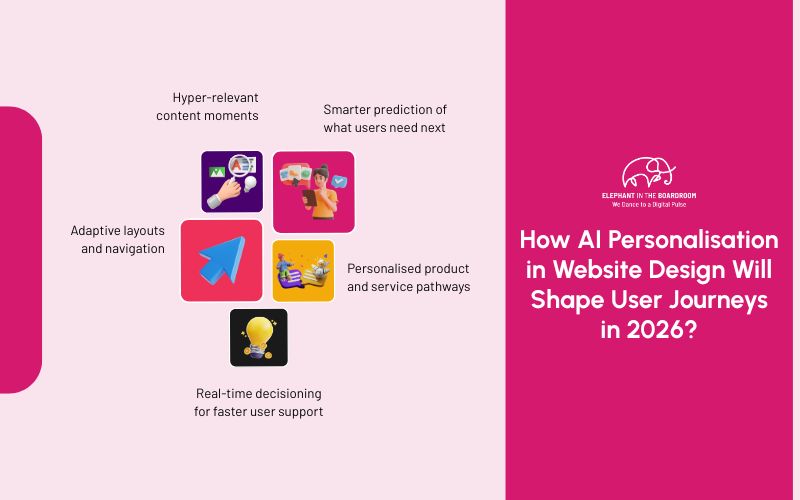
In 2026, AI personalisation will raise the standard for what users expect from seamless and intuitive website experiences. The next wave of web design will focus on environments that shift in real time to support user intent and behaviour.
Hyper-Relevant Content Moments
Websites will serve content based on real-time behaviour, user intent, and session context. You will deliver information that aligns with what the visitor is trying to achieve right now, reducing friction and boosting engagement instantly.
Smarter Prediction of What Users Need Next
Predictive models will help websites understand behavioural patterns, allowing the site to guide visitors toward the most useful path. Whether it is showing a relevant service, surfacing a helpful tool, or recommending the next action, the journey feels more seamless.
Adaptive Layouts and Navigation
Interfaces will adjust based on how users interact, menus reorganising, buttons shifting priority, and content blocks reshaping to match the visitor’s behaviour. This creates a smoother flow and reduces the drop-offs caused by cluttered or irrelevant layouts.
Personalised Product and Service Pathways
Instead of generic pages, visitors will receive tailored pathways aligned with their browsing history, goals, and preferences. This boosts conversion by helping users feel understood and supported from the moment they land on the site.
Real-Time Decisioning for Faster User Support
AI will trigger personalised prompts, tools, or help widgets exactly when visitors need them. You will be able to offer timely support, like nudging them toward the right resource or helping them complete a stalled action, without overwhelming the experience.
AI Personalisation in Website Design: Key Steps to Get Started Today
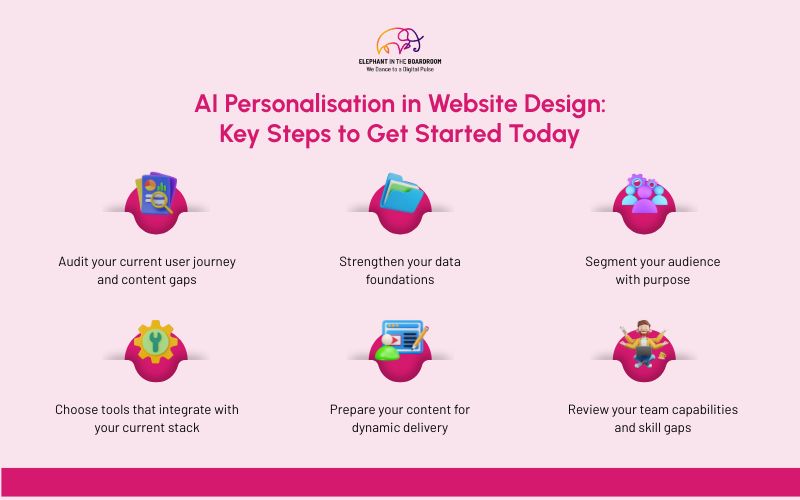
Before 2026 reshapes how websites deliver personalised experiences, it pays to get your foundations in place. Here’s what you can start doing now to set your site up for smarter user journeys:
Audit Your Current User Journey and Content Gaps
You need clarity on how people currently move through your website. Look at your analytics, identify drop-off points, review your top-performing pages, and assess which sections fail to guide users forward.
Strengthen Your Data Foundations
Quality data is essential for any personalisation engine to work effectively. Clean, ethical, and privacy-compliant data allows AI tools to make accurate decisions and maintain user trust.
Segment Your Audience With Purpose
While machine learning will eventually automate segmentation, starting with clean, purposeful audience groups helps the system learn faster. Build segments based on intent, lifecycle stage, and real on-site behaviour.
Choose Tools That Integrate With Your Current Stack
The best personalisation platforms are the ones that fit smoothly into your website’s CMS, analytics tools, and CRM. Before the new year, map out your tech stack and assess compatibility. Look for systems that offer real-time triggers, predictive modelling, and the ability to scale as your needs evolve.
Prepare Your Content for Dynamic Delivery
AI personalisation relies on content that can be swapped, adapted, or sequenced based on user behaviour. Start preparing modular content blocks, alternative headlines, segmented value propositions, and flexible CTAs.
Review Your Team Capabilities and Skill Gaps
As AI personalisation becomes more common, teams will need familiarity with data interpretation, experience mapping, content structuring, and AI tool management. Use the months ahead to upskill your team, refine internal processes, or identify where you may need new expertise.
Take Your Next Digital Leap with AI Personalisation in Website Design
Your website has a massive opportunity waiting to be unlocked, and 2026 won’t slow down for anyone. Brands that move now will lead the next wave of digital experiences, and Elephant in the Boardroom is here to help you take that leap with confidence, clarity and a touch of bold innovation that actually feels alive in-market.
If you’re ready for a website that adapts, engages and guides users in a way that feels effortless, it’s the perfect moment to team up with a crew who treats personalisation as a business advantage. Let’s elevate your digital performance and build something that wins attention the second someone lands on your page. Reach out to Elephant in the Boardroom today and get your next move in motion.

Pia - Content Blogging Specialist
Pia is a Content Blogging specialist at Elephant in the Boardroom, where she develops structured, search-led content designed to inform and convert. With 6+ years of experience in digital content and SEO writing, she brings expertise in long-form blogging, topic authority, and audience-first storytelling. Pia contributes insights on content strategy, editorial best practice, and organic growth, drawing on experience supporting brands operating at scale.