What Is AI Chat Sentiment Analysis and How It Transforms Customer Experience
Rosalind Picard once said that machines may not feel, but they can learn to recognise and respond to human emotions, and that idea now sits at the centre of every digital conversation your brand runs. Your business is already talking all day, every day, through chat. Some exchanges feel effortless. Others quietly miss the tone. Most pass without anyone really knowing how they landed. AI chat sentiment analysis lives in that unseen space, tuning into the emotional signals your AI handles at scale. If you care about how your brand sounds when no one is watching, and how those moments shape loyalty, trust, and growth, this is where the story starts.
What’s Inside:
- AI Chat Sentiment Analysis: Core Concepts and How It Works
- Common Use Cases and Applications of AI Chat Sentiment Analysis
- How AI Chat Sentiment Analysis Transforms Customer Experience
- Let AI Chat Sentiment Analysis Drive More Meaningful Engagement
AI Chat Sentiment Analysis: Core Concepts and How It Works
AI chat sentiment analysis focuses on how something is said during a conversation, not just what is said. It analyses text from chat-based interactions, live chat, chatbots, messaging platforms, and support tickets, to identify emotional signals such as frustration, urgency, hesitation, or confidence.
At a technical level, sentiment analysis uses natural language processing (NLP) and machine learning models trained on large volumes of conversational data. These models evaluate language patterns, word choice, phrasing, punctuation, and context across entire messages rather than isolated keywords. This allows sentiment to be interpreted in a manner that reflects the natural flow of conversation.
In chat environments, sentiment analysis typically works in near real time or post-conversation. Messages are processed as they are sent, or once a conversation is complete. Each message, or the conversation as a whole, is then classified into sentiment categories such as negative, neutral, or positive, often with additional confidence or intensity scoring.
Modern AI systems go beyond simple polarity detection. They account for conversational nuances, such as:
- Shifts in tone across a chat session
- Repeated signals of uncertainty or resistance
- Escalating language patterns over time
- Contextual meaning based on prior messages
This is what makes sentiment analysis suitable for chat-based use cases, where meaning builds progressively rather than appearing in a single line.
Importantly, AI chat sentiment analysis does not replace human judgement. It provides structured signals that can be used by systems and teams to make informed decisions about routing, prioritisation, and follow-up.
Common Use Cases and Applications of AI Chat Sentiment Analysis
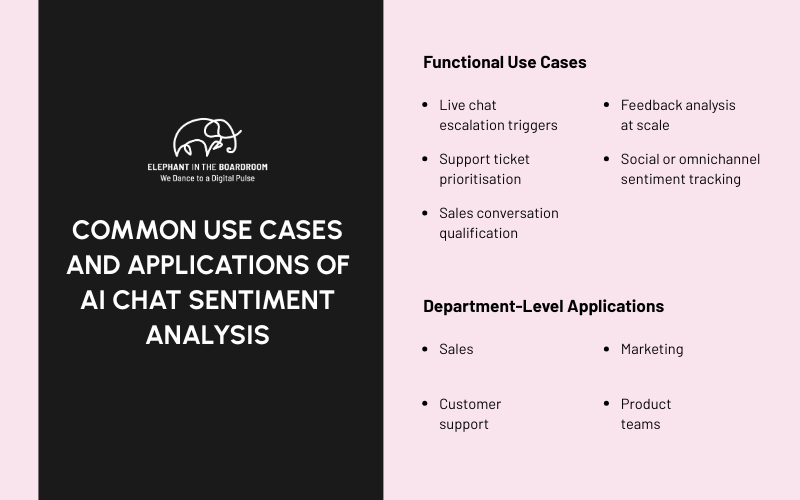
AI chat sentiment analysis is used wherever organisations manage high volumes of conversational data and need consistency in how conversations are assessed. Below are the most common functional and departmental applications.
Functional Use Cases
Live Chat Escalation Triggers
Sentiment analysis can flag conversations where language patterns indicate rising frustration, confusion, or urgency. These signals are used to prompt escalation rules, such as transferring a chat to a senior agent or adjusting response handling.
Support Ticket Prioritisation
When chat transcripts are converted into support tickets, sentiment data can be attached to help sort incoming requests. Tickets can be grouped or ordered based on emotional intensity rather than arrival time alone.
Sales Conversation Qualification
In sales chats, sentiment analysis helps identify signals such as hesitation, resistance, or readiness to proceed. These insights can be logged alongside conversation data to support qualification workflows.
Feedback Analysis at Scale
Chat transcripts often contain unsolicited feedback. Sentiment analysis allows teams to scan large volumes of chat data to identify recurring emotional patterns without manually reviewing each conversation.
Social and Omnichannel Sentiment Tracking
When chat platforms are integrated with social messaging, email, or in-app messaging, sentiment data can be tracked across channels. This creates a consistent way to assess tone regardless of where the conversation occurs.
While functional use cases describe what sentiment analysis enables, department-level applications show how different teams apply those signals in practice.
Department-Level Applications
Customer Support
Support teams use sentiment signals to manage workload distribution, queue handling, and case review. Sentiment tagging provides additional context beyond issue type or category.
Sales
Sales teams apply sentiment analysis to chat conversations to support lead triage, handover notes, and follow-up planning. The focus is on conversational signals rather than outcomes.
Marketing
Marketing teams analyse sentiment across chat interactions to understand how messaging, campaigns, or offers are being received in live conversations. This data complements survey and behavioural data.
Product Teams
Product teams review sentiment trends across chat logs to identify friction points, recurring confusion, or language patterns tied to specific features. Chat sentiment becomes another input alongside usage data and support feedback.
How AI Chat Sentiment Analysis Transforms Customer Experience
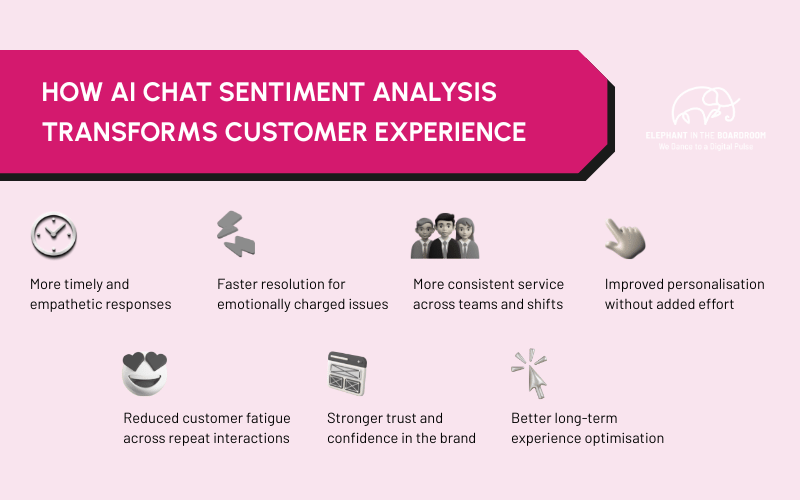
Customer experience is shaped in the moments where conversations either build trust or quietly erode it. AI chat sentiment analysis helps you recognise those moments as they happen, so you can respond with clarity, relevance, and care.
Key ways it transforms the customer experience:
More Timely and Empathetic Responses
When emotional signals are detected early, conversations can be handled with the right tone and urgency. This reduces situations where customers feel ignored, rushed, or misunderstood during critical moments.
Faster Resolution For Emotionally Charged Issues
Conversations showing frustration or urgency can be addressed sooner, limiting back-and-forth that drains patience. Customers experience fewer delays and a clearer sense that their concerns are being taken seriously.
More Consistent Service Across Teams and Shifts
Sentiment signals provide a shared layer of context, regardless of who handles the conversation. This helps ensure customers receive a similar level of care and responsiveness, even as agents change.
Improved Personalisation Without Added Effort
Understanding emotional tone allows responses to be shaped around how the customer is feeling, not only what they are asking. This makes interactions feel more human, without requiring agents to manually interpret every nuance.
Reduced Customer Fatigue Across Repeat Interactions
When sentiment history is carried across conversations, customers do not need to restate their frustration or urgency. This continuity helps prevent negative experiences from compounding over time.
Stronger Trust and Confidence in the Brand
Customers notice when conversations are handled thoughtfully and appropriately. Over time, this builds confidence that your business listens, responds appropriately, and respects their time.
Better Long-Term Experience Optimisation
Patterns in sentiment highlight where customers feel confused, blocked, or reassured most often. These insights support experience improvements that directly reflect how customers feel during real interactions.
Let AI Chat Sentiment Analysis Drive More Meaningful Engagement
Customer conversations are already happening on your website. The question is whether they’re working hard enough for your brand. At Elephant in the Boardroom, we help you turn everyday chat into a powerful experience that feels personal, intuitive, and built around how your customers respond.
From intelligent, user-focused websites to full-stack development, refined UI/UX, and content that guides action, we design platforms that connect, convert, and grow with your business. If you’re ready to create digital experiences that feel sharper, more human, and impossible to ignore, let’s start the conversation.

Candace - Co-Founder and Head of Marketing
Elephant Candace is Co-Founder and Head of Marketing at Elephant in the Boardroom, where she leads brand, growth, and digital strategy across multi-channel platforms. With over 10 years of experience in digital marketing, web development, and performance strategy, she brings expertise in customer acquisition, conversion optimisation, and data-driven storytelling. She contributes insights on modern marketing, AI-led growth, and digital transformation, drawing on experience working with enterprise-scale organisations and cross-functional global teams.